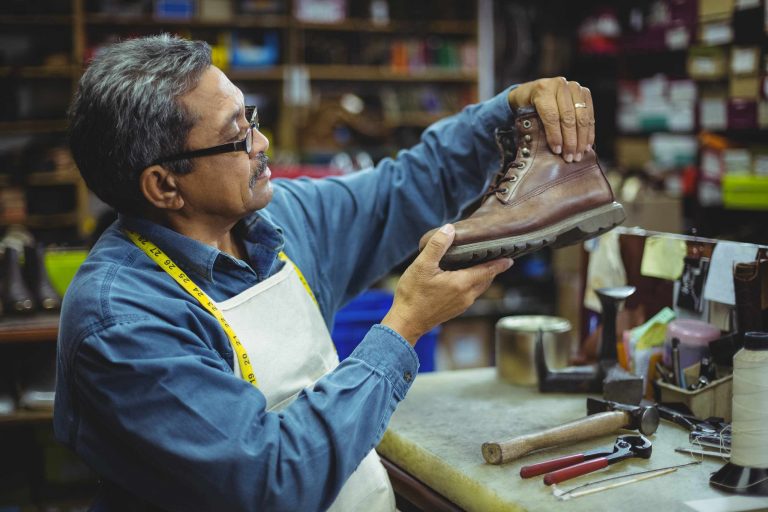

A completed shoe may appear to be a single unit, but its final shape depends on a number of distinct elements. It is helpful to understand the function of these elements before cutting the pattern pieces or starting the upper assembly. Knowing the name of the element by itself is not sufficient. We need to understand how each part influences the overall shape, provides support, determines the order of construction, and affects the placement of subsequent parts.
The upper is the portion of the shoe that surrounds the foot above the sole. Depending on the style of shoe, it may consist of individual components, such as the vamp covering the front, the quarters on the sides and back, the tongue, and the eye stays near the laces. These components are typically cut out individually and assembled using a specific upper assembly sequence. The length of their seam allowances, the placement of the stitches, and the direction of the grain are important factors because even minor variations can alter the final shape of the shoe. One useful exercise is to take a number of pattern pieces and arrange them on a table, attempting to recognize where each piece will ultimately belong in the finished shoe without sewing anything.
In addition to the individual components that form the upper, a lining covers the interior of the shoe and may be designed to provide comfort and organization for seams and reinforcement pieces. Reinforcement components are additional pieces that may be incorporated for extra strength. The heel counter is a component that provides structure to the rear of the shoe, and there are toe boxes or similar reinforcement pieces that may be utilized to provide structure to the front of the shoe. These components are not merely hidden pieces; the location, alignment, and thickness of these components may affect how the upper behaves when it is stretched over the shoe last in the process of lasting.
The insole is the foundation for the shoe. During the process of lasting, the upper is wrapped around the last and attached to the insole. The shoe last is not technically a part of the shoe; however, it is a critical tool for constructing the shoe. By marking the center of both the upper and the last, we can easily determine whether or not the two are aligned. If the upper has moved out of alignment during the toe or heel lasting process, having the center marked on both items will help us quickly adjust the upper to its proper position rather than trying to visually estimate the alignment.
Depending on the style of the shoe, the insole may have a midsole and outsole. The outsole is the external bottom surface of the shoe that comes in contact with the ground. Its position needs to be properly aligned with the shape of the upper and the expected edge of the sole. Prior to permanently attaching the outsole, the surfaces to be adhered together must be properly prepared according to the type of material and adhesive being used. Often, beginners focus exclusively on attaching the sole to the shoe, which causes them to overlook misalignment issues at the toe or heel. To address this, it is beneficial to fit the outsole to the shoe prior to gluing it down, and inspect the alignment from various angles.
To better learn the components of the shoe, try conducting a component analysis exercise without constructing a complete shoe. Take a diagram, pattern, or practice shoe and lay out the components representing the upper, lining, reinforcement, insole, outsole, and last. Arrange the components roughly in the order in which they would be used during shoe construction. Study the relationship between the various components. Determine which components are joined together by stitching, which components are used to shape the upper, which components are manipulated during the lasting process, and which components require accurate alignment prior to joining. This exercise takes a list of unfamiliar terms and converts them into a process.
One indicator that I am beginning to understand these components is that when I see a shoe, my mind moves past the visual appearance of the shoe to consider the components that were used to construct it. I begin to notice where the vamp is attached to the quarter, where a heel counter is reinforcing the heel area, how the upper was shaped to conform to the shape of the last, and how the outsole is aligned to the finished shape of the shoe. Being able to visualize the shoe in this manner helps me understand what I need to do when I prepare the pattern, cut the components, assemble the upper, and complete the lasting and finishing operations.